
Being in the military is a lifestyle as much as a vocation. Frequent moves, tight-knit community ties, unique financial rhythms, and a high value placed on trust and service all shape how service members, veterans, and their families discover and evaluate brands. For companies seeking to meaningfully connect with this audience, understanding the emotional and rational drivers and adapting marketing strategies accordingly is essential.
Long story short, you have to know this audience to make headway in the military marketing space.
The Forces Acting on Military Audiences
Scale and Scope. There are roughly 34 million military-affiliated consumers in the U.S. That’s about 10% of the population. This is a sizable consumer bloc with geographic clusters that give brands a targetable consumer segment for marketing campaigns. DON’T IGNORE THIS AUDIENCE.
Mobility is Baked into the Lifestyle. More than 400,000 service members move through permanent change of station (PCS) assignments every year, and roughly one-third of active service members will face PCS moves annually. That creates frequent windows for purchase decisions, including moving-related spending on housing, vehicles, appliances, insurance, and local services. This also creates an inherent increase in the value of location-independent offers and multi-location, national brands. (Military OneSource)
Military Moves are Expensive. The Department of Defense spends billions of dollars annually on moving personnel and families; that cost burden filters down to the household level in hidden ways (temporary housing needs, replacement purchases, and timing of big-ticket buys). Brands that help smooth the moving experience can earn loyalty by removing friction at a stressful (and expensive) moment. (U.S. Department of Defense)
Trust and Community Matter More. Loyalty in the military community is often less transactional and more relational. What this means is that service members and veterans gravitate toward companies that demonstrate authentic support. In other words: veteran hiring, community investment, or meaningful partnerships with military nonprofits. When companies visibly support the military community, they earn longer-term loyalty. (Cushman & Wakefield Careers)Digital and Social Networks are Lifelines. Matching the trend in the general market, military families use social media and internet platforms not just socially but functionally. They search for housing recommendations, relocation tips, vetted local vendors, and peer reviews. Social media has become a de facto search engine. And during separations or moves, these activities are enhanced even further. That means earned credibility on social platforms is often more valuable than broad, brand splash advertising. (SAGE Journals)
The Forces Acting on Military Audiences
Scale and Scope. There are roughly 34 million military-affiliated consumers in the U.S. That’s about 10% of the population. This is a sizeable consumer bloc with geographic clusters that give brands a targetable consumer segment for marketing campaigns. DON’T IGNORE THIS AUDIENCE.
Mobility is Baked into the Lifestyle. More than 400,000 service members move through permanent change of station (PCS) assignments every year, and roughly one-third of active service members will face PCS moves annually. That creates frequent windows for purchase decisions, including moving-related spending on housing, vehicles, appliances, insurance, and local services. This also creates an inherent increase in the value of location-independent offers and multi-location, national brands. (Military OneSource)
Military Moves are Expensive. The Department of Defense spends billions of dollars annually on moving personnel and families; that cost burden filters down to the household level in hidden ways (temporary housing needs, replacement purchases, and timing of big-ticket buys). Brands that help smooth the moving experience can earn loyalty by removing friction at a stressful (and expensive) moment. (U.S. Department of Defense)
Trust and Community Matter More. Loyalty in the military community is often less transactional and more relational. What this means is that service members and veterans gravitate toward companies that demonstrate authentic support. In other words: veteran hiring, community investment, or meaningful partnerships with military nonprofits. When companies visibly support the military community, they earn longer-term loyalty. (Cushman & Wakefield Careers)
Digital and Social Networks are Lifelines. Matching the trend in the general market, military families use social media and Internet platforms not just socially but functionally. They search for housing recommendations, relocation tips, vetted local vendors, and peer reviews. Social media has become a de facto search engine. And during separations or moves, these activities are enhanced even further. That means earned credibility on social platforms is often more valuable than broad, brand splash advertising. (SAGE Journals)
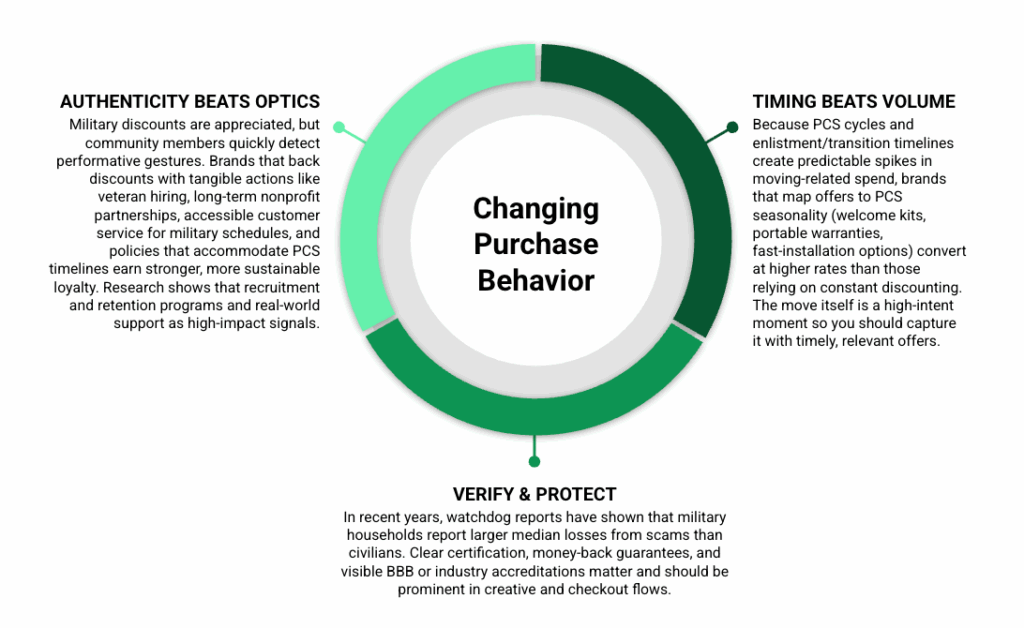
Tactical playbook for brands
If you’re reading this and feeling like you don’t know how to move from theory to practice with your military marketing efforts, never fear. We’ve got you covered.
At the most basic level, you should understand that this works like any other targeted marketing effort. We’re just identifying some different leverage points and emotional drivers for military audiences.
Here’s a brief overview to get you started on your military marketing journey:
- Map PCS and transition moments to lifecycle messaging. Build campaign calendars around common PCS windows and separation/transition periods (and target geo-clusters with high veteran concentration). Use relocation-focused creative and friction-reducing offers (free assembly, flexible returns, expedited shipping).
- Build local partner ecosystems. National brands win trust via vetted local providers (installers, movers, child care referrals). Co-branded local landing pages and “move concierge” content convert better than generic landing pages.
- Earn trust with service-first credentials. Publish clear verification of veteran support (hiring stats, donations, program outcomes), highlight BBB/accreditations and consumer-protection policies, and provide straightforward FAQs about returns, reimbursements, and timing for PCS situations. (bbbmarketplacetrust.org)
- Activate peer networks. Sponsor, partner, and authentically participate in military community forums, social media groups, and military spouse networks where recommendations are currency. Invest in influencer programs with real military voices (not one-off sponsorships).
- Authentic creative executions. Build creative and write copy in your marketing executions that show the authentic lifestyle and speak the authentic language of the military. Speak to the audience rather than at them. Make them feel seen, respected, and understood.
- Design for mobility. Product design, packaging, installation, and warranty communication should all be designed to accommodate frequent relocations. Portable warranties, transferable service plans, and lightweight packaging are small features that relieve big pain points.
Final thought
Advertise with empathy; design for mobility; demonstrate durable support; and meet consumers where they really exchange value (in trusted networks and at life’s hinge moments). For brands that do the work, military consumers reward authenticity with outsized loyalty and lifetime value.
And, as always, don’t be afraid to reach out for some help from your friends at bBIG.